No plan
Research: Many grocery purchases are unplanned, which leads to buying food that never gets eaten.
The book: A 28-day dinner plan: you know what you’re cooking each night and what to buy for it.
50 Pennsylvania Dutch–inspired recipes, a 28-day dinner plan for households of 2–5 with the shopping lists already written, and seven ways to turn the ingredients you buy into several meals. See what each recipe costs, when homemade is worth it, and how to put leftovers to use.
Full PDF book · Interactive browser edition · Audio for every recipe · Printable planning pages
One-time purchase. Digital files. No physical book is shipped.
* U.S. EPA, Estimating the Cost of Food Waste to American Consumers (2025): about $728 per person and $2,913 per household of four a year, in 2023 dollars, counting food wasted at home and when eating out. National averages; your household will differ. How the book helps

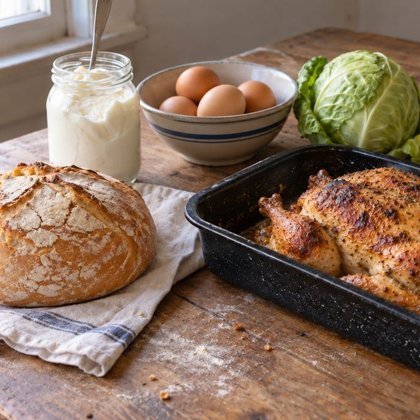 50 recipes · a month of dinnersOld Amish Kitchen · No. 1
Careful with food, careful with money. Americans throw away $728 of it a year each.
Amos · EPA, 2025** Our estimate from the book’s prices: a family of five that bakes its bread, makes broth from the bones and cooks dried beans instead of buying canned saves about $375 a year on those three items alone, repeating the 28-day plan through the year. Ingredient costs only, August–October 2026 prices; yours will differ.
That’s how much an average American household of four throws away, according to the U.S. Environmental Protection Agency (2025): about $728 per person, roughly 11% of everything spent on food. ReFED, a national food-waste nonprofit, puts it even higher, close to $800 per person. Studies keep naming the same four reasons, and the book answers each one:
Research: Many grocery purchases are unplanned, which leads to buying food that never gets eaten.
The book: A 28-day dinner plan: you know what you’re cooking each night and what to buy for it.
Research: People buy for the deal, or without a clear sense of how much a recipe takes.
The book: Weekly shopping lists in whole packages, worked out separately for 2, 3, 4 and 5 people.
Research: Many people don’t know how to store food, so it spoils before it’s used.
The book: A part on keeping food: where things go in the fridge, how long they keep, how to use the freezer, plus freezer labels.
Research: Few people have practice turning leftovers into another meal.
The book: Seven chains where the leftovers of one dish are an ingredient of the next, plus six recipes for the last of everything: croutons, banana bread, bread pudding, rice pudding.
$2,913 is a national average that counts all the food a household wastes, at home and when eating out, not only dinners. The book works on the part that happens in your own kitchen; how much you save depends on how much your family throws away now.
Sources: U.S. EPA, Estimating the Cost of Food Waste to American Consumers (2025): $728 per person and $2,913 for a household of four a year, about 11% of food spending, in 2023 dollars. ReFED, Rethinking Food Waste: Understanding Consumer Food Waste (July 2025): nearly $800 per person. ReFED, Food Waste: Causes & Impacts: the causes listed above.
Tick what sounds like you. The estimate uses U.S. research on what households throw away and why, scaled to your household size.
Rough estimate, not a measurement of your kitchen. We took the EPA’s $728 per person a year and split it by the reasons households gave in NRDC’s kitchen-diary study, leaving out inedible scraps such as bones and peels. The EPA figure also counts food wasted when eating out, and NRDC’s shares are by weight, from three U.S. cities in 2017, so treat these numbers as an upper estimate; your family’s habits and prices will differ. Two habits have no separate dollar figure in the research, so we don’t invent one.
Sources: U.S. EPA, Estimating the Cost of Food Waste to American Consumers (2025) — $728 per person a year, 2023 dollars. NRDC, Estimating Quantities and Types of Food Waste at the City Level (2017) — reasons for discarding: moldy or spoiled 20%, didn’t want as leftovers 11%, left out too long 7%, past the label date 4%, too little to save 4%, inedible parts 44%.
The book is built on chains. In some, one purchase carries through several meals; in others, dinners share the same cheap ingredients, so nothing sits until it spoils. Six of the book’s seven chains:
Five dinners from the plan, cheapest first. Choose how many people you cook for.
6+: the book’s tables go up to five people, so for larger families we show the average cost per person across its 2–5 columns. Multiply by the number of people you cook for.
Book estimates for the ingredients that go into the pot, at the book’s August–October 2026 prices, before tax. At the checkout you pay for whole packages; what’s left goes into the next meals. Your prices will differ.
Homemade isn’t always cheaper. For every item it compares, the book puts the homemade cost next to the closest store product at the same weight and gives an honest verdict: make it, buy it, or it depends. Where the store wins, it says so—no need to spend an evening saving nothing. Four examples:
Saves about $2 a loaf. Store price: 1.4 lb of white sandwich bread.
A whole head against a bag of coleslaw mix, the same weight.
Cheese takes a lot of milk to make a little cheese, so the tub wins.
A raw bird of about 4½ lb against a cooked rotisserie of about 2¼ lb. They are not equal purchases: which costs less depends on the edible cooked yield and your local prices.
Ingredient costs only. Your time, energy and equipment are not included. In the book, homemade broth counts only the vegetables, because it uses the bones of a chicken you have already paid for.
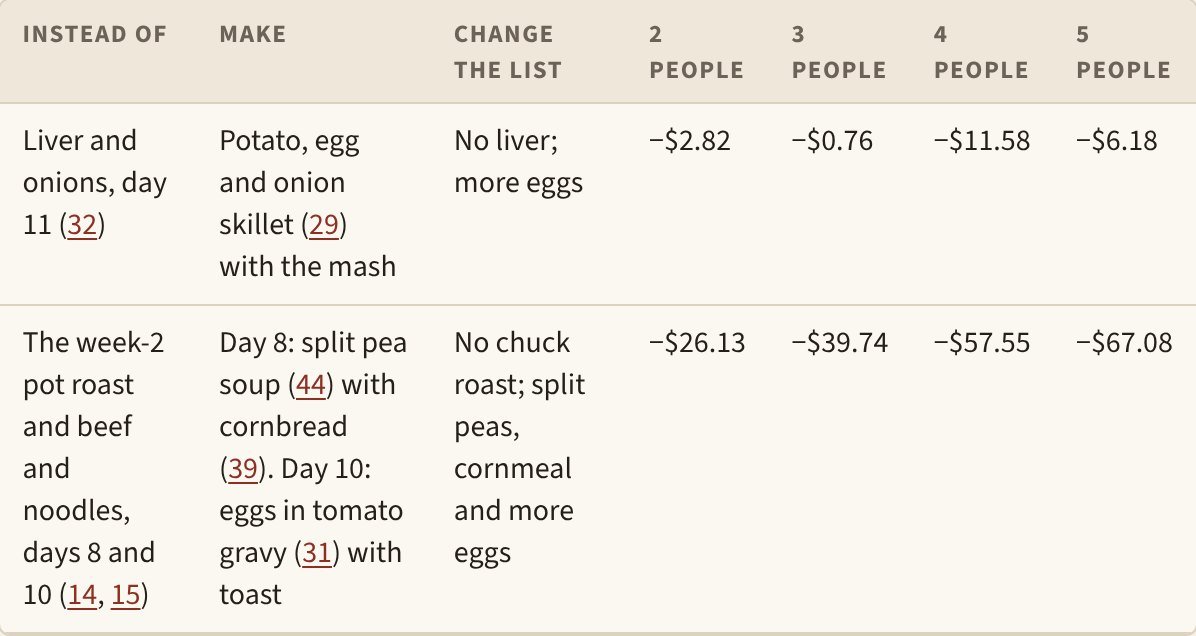
Ready swaps that keep the plan working, with what changes on the shopping list and in the month’s total for 2–5 people. The menu doesn’t rebuild itself; the book shows you the swap.
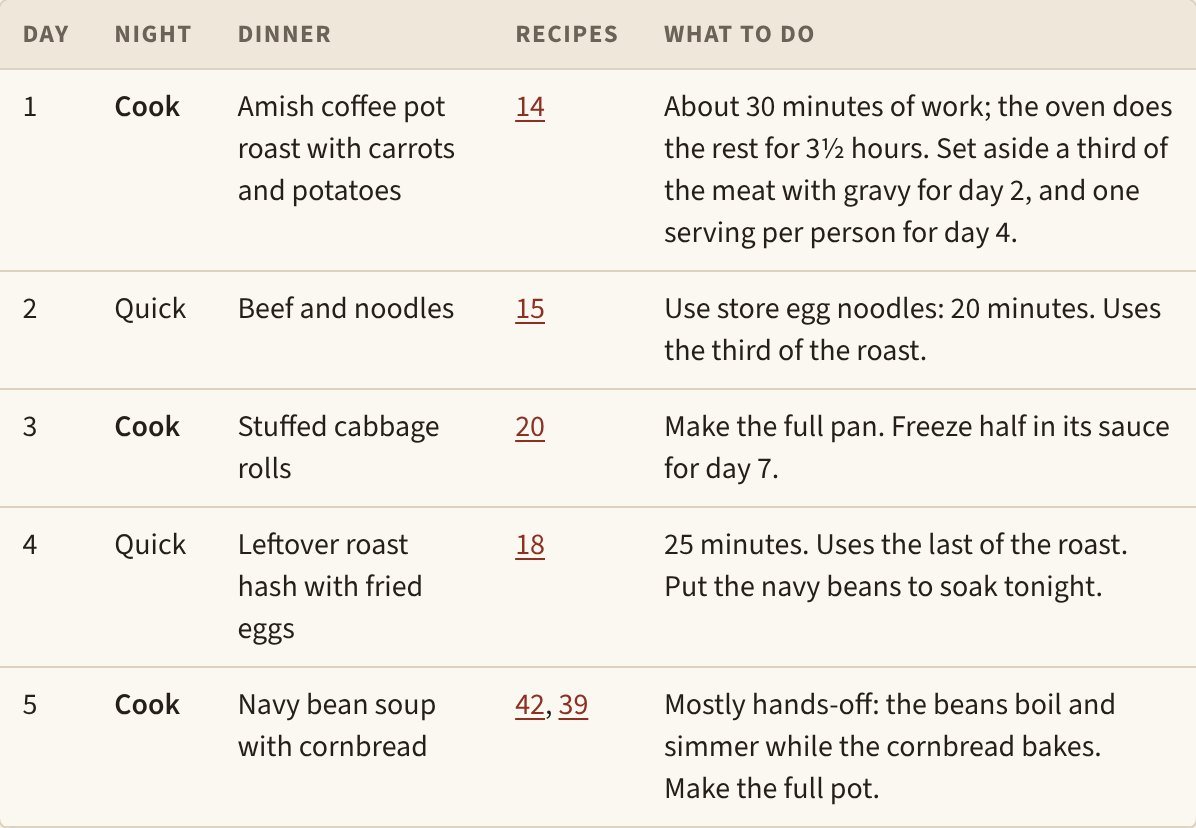
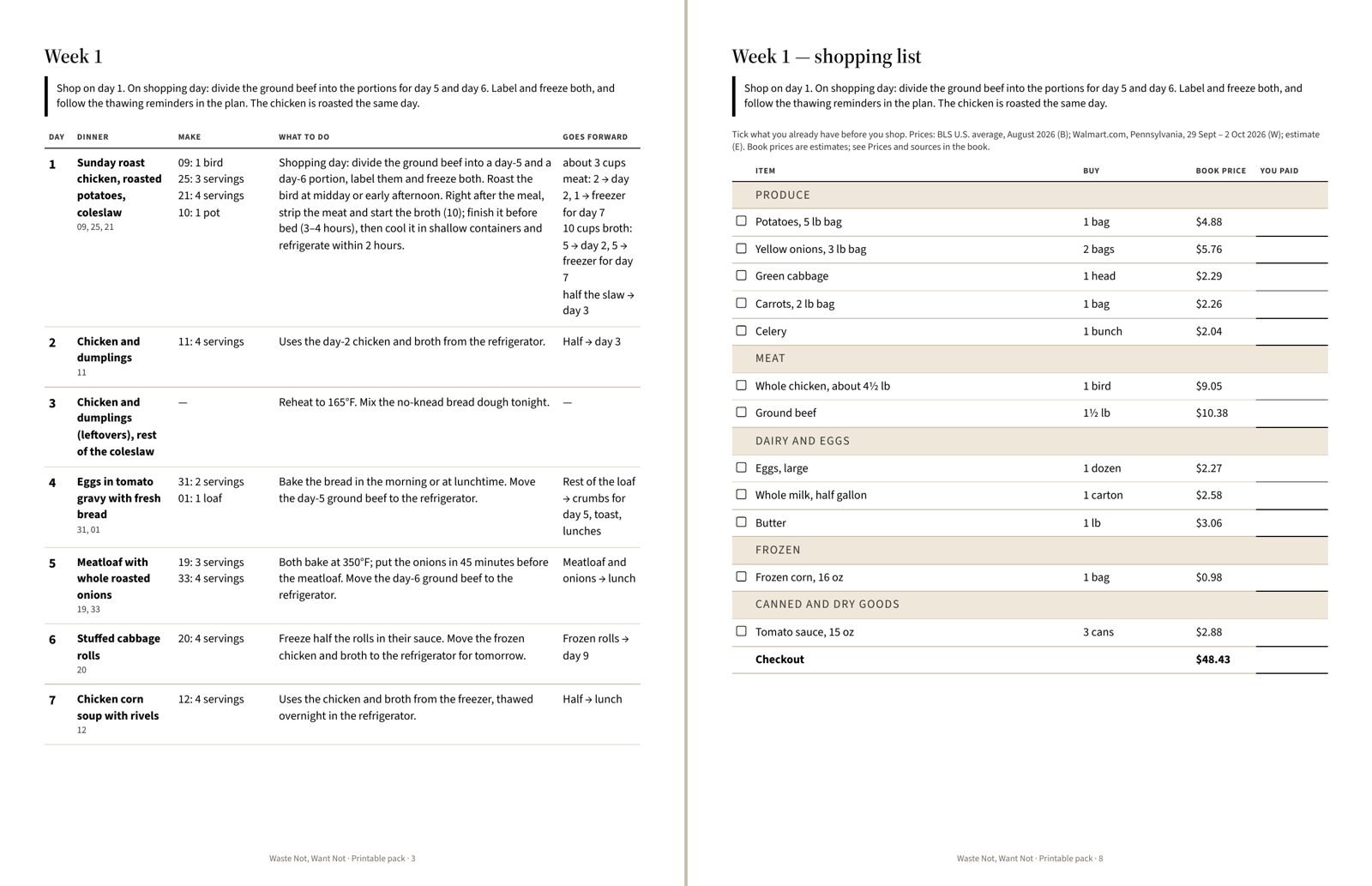
A separate busy-week plan: 3 cooking nights, 2 quick dinners of 25 minutes or less, 2 reheats, with its own shopping list.
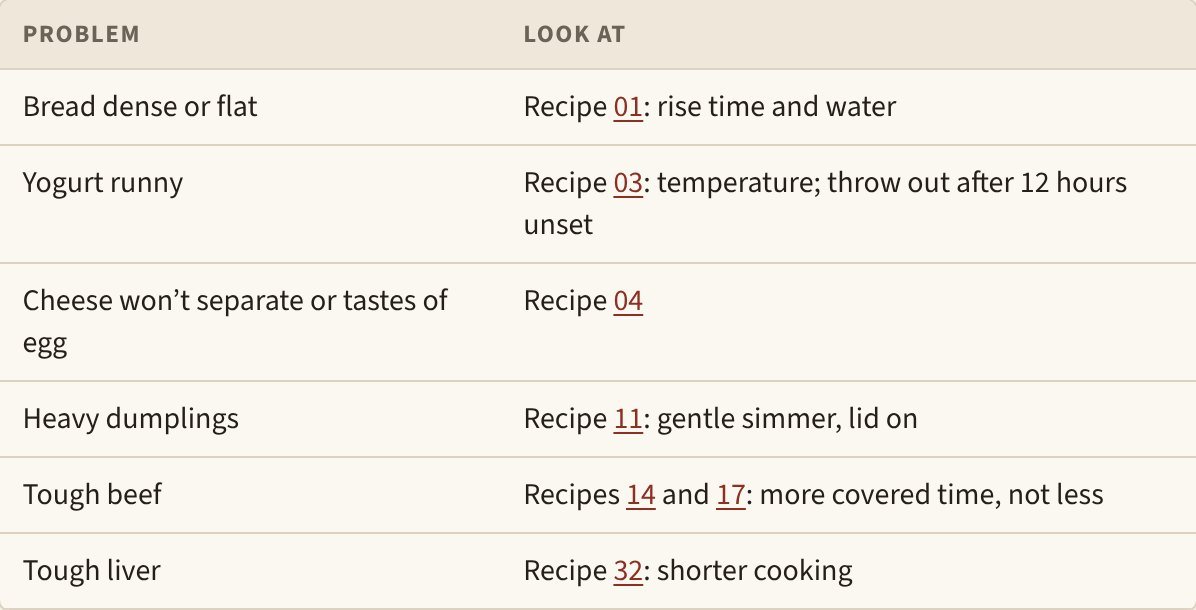
Every recipe has an “If it goes wrong” note, plus a quick table for the usual problems: dense bread, tough beef, heavy dumplings.
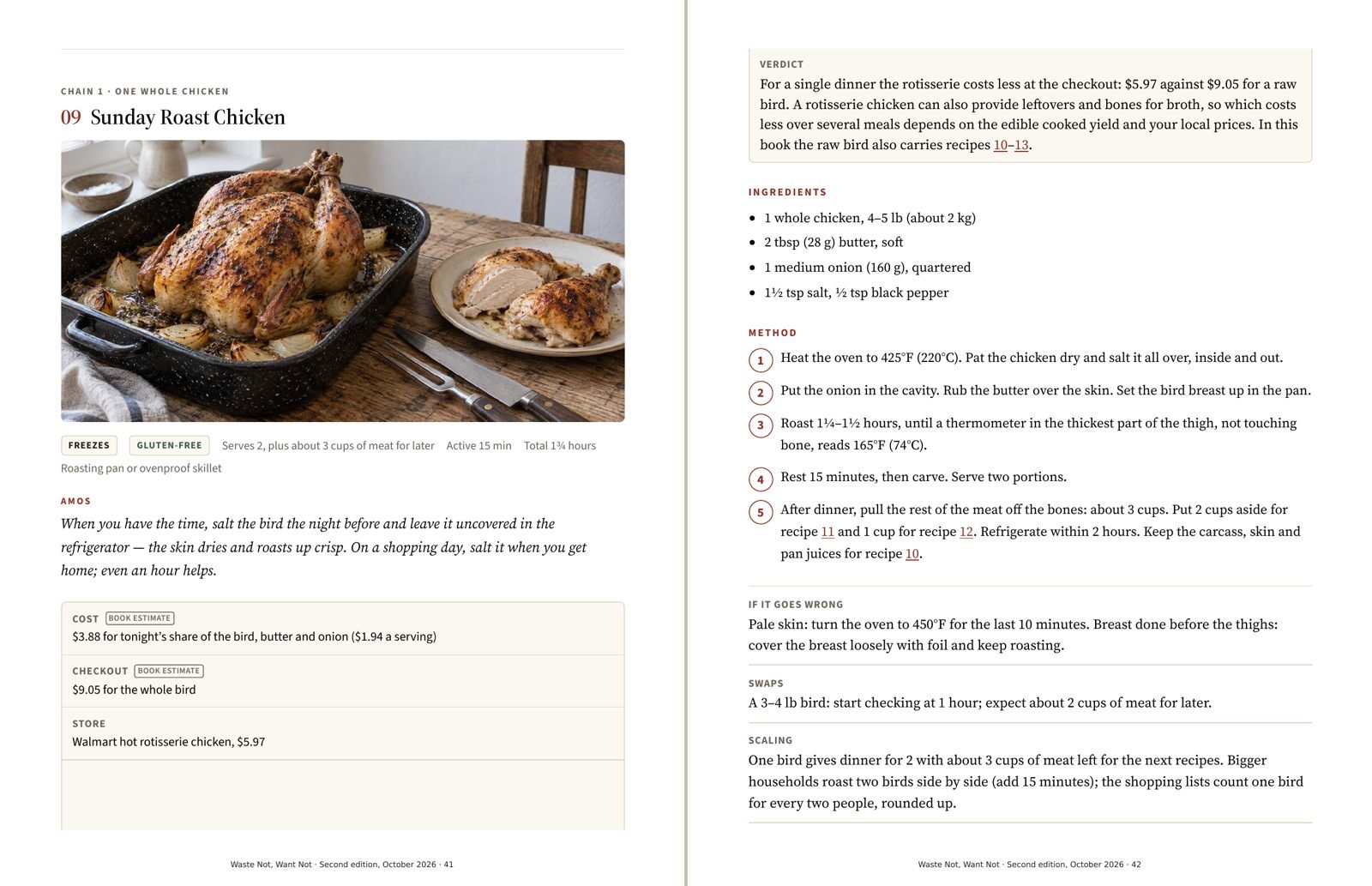
These are pages from the second edition, as they appear in the files you get: the browser edition, the PDF book and the printable pack.
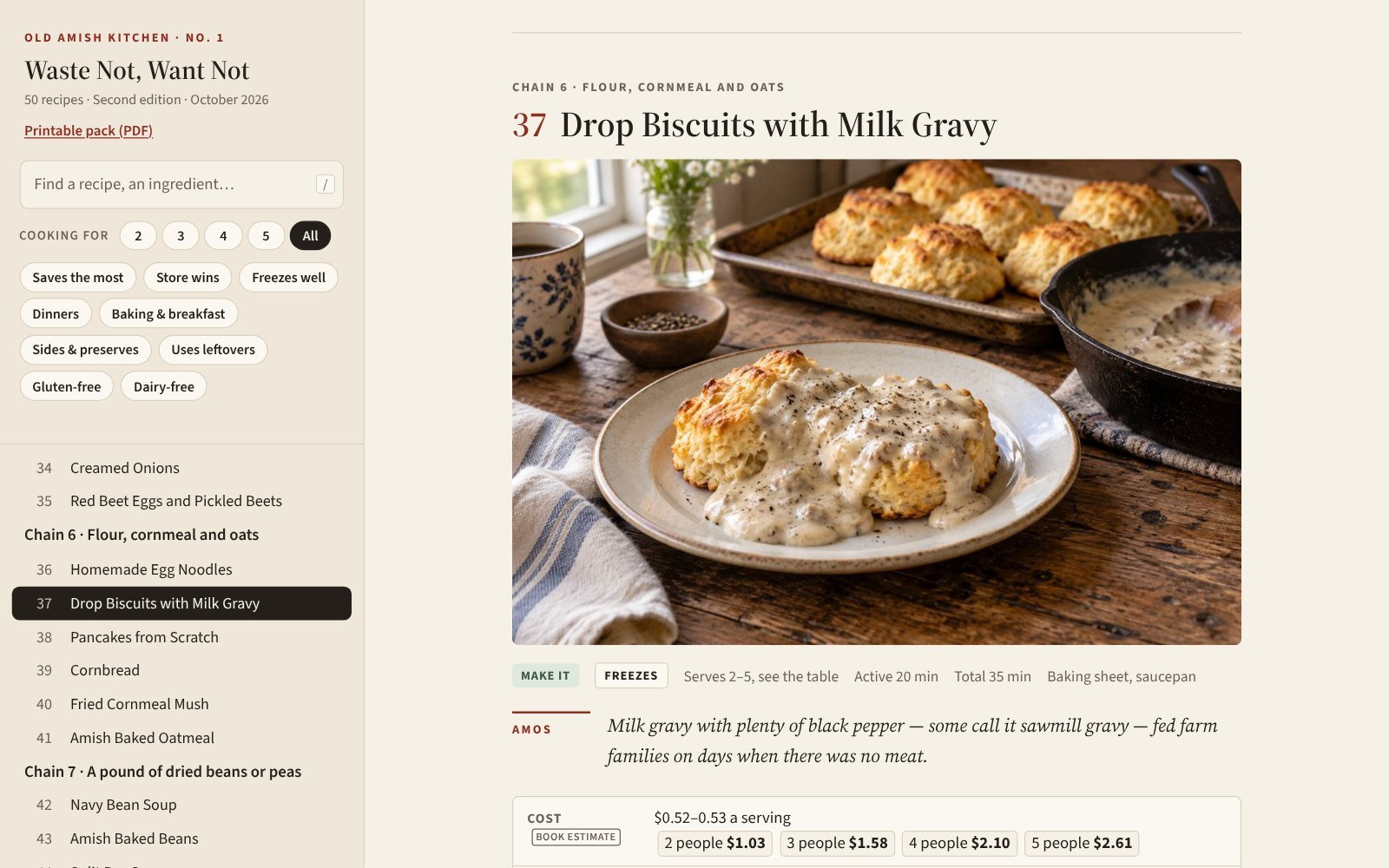
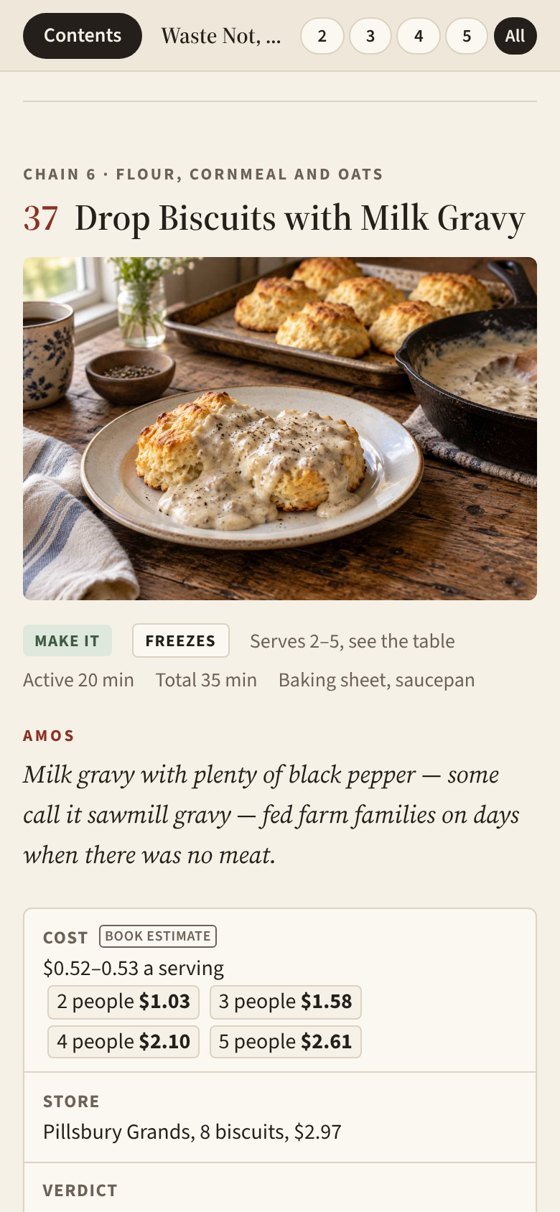
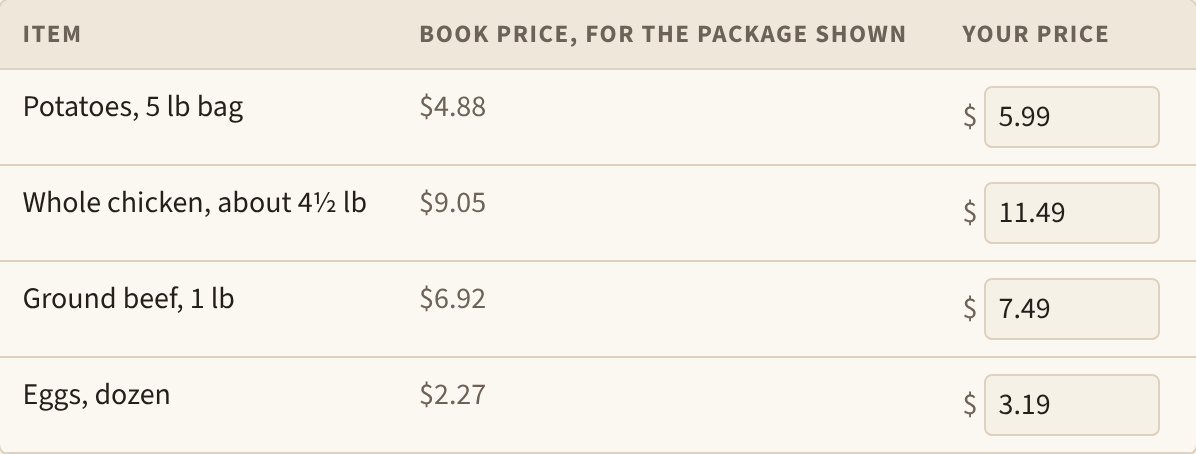
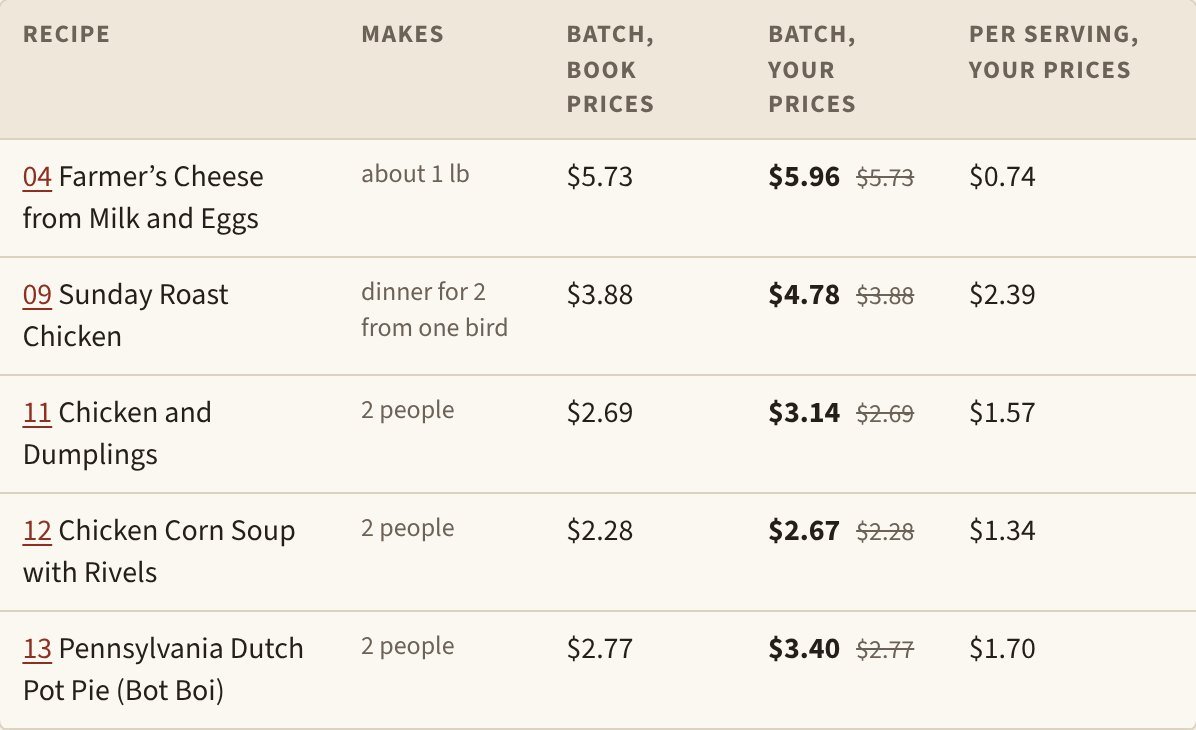
Prices differ from town to town. In the browser edition, type in what you pay for the basics you buy—just the ones you know. The rest keep the book’s price.
In the calculator tables the book’s price stays next to yours, crossed out, so you can see the difference. Your prices are saved only in your browser, on your device. Recipe pages, the month table in the plan section and the PDFs keep the book’s dated prices.
Hands in the dough, eyes on the pan. Press play and the recipe is read to you step by step, so you don’t have to keep looking back at a screen or a page. It’s also there for anyone who finds small print hard going.
Read the PDF in your usual PDF reader. Use the browser edition for search, filters and the price calculator.
In old Pennsylvania Dutch kitchens, food was never something to throw away. Stale bread became pudding, the bones went into the stock pot, and Sunday’s roast came back on Monday with homemade noodles. Nobody called it saving money. It was respect for what you’d bought and for the hands that grew it.
This book carries that way of cooking into a modern kitchen: a pot on the stove, the family around the table, a house that smells of supper, and a grocery bill that goes further.
I’m usually standing in front of the fridge at five o’clock wondering what we’re having for dinner. The weekly plan gives me somewhere to start, and I can swap meals around when our schedule changes. That’s probably my favorite part of the book.
I started with the chicken recipes because that’s something we already buy. What helped was knowing how much meat to save for the next meal instead of serving it all at once. It made the leftovers feel planned, which is a new thing in my kitchen.
The first thing I looked at was the make-or-buy section. I’ve tried making everything from scratch before, and I never kept it up. This feels more manageable. I can pick a couple of things to make at home and keep buying the rest.
I wanted ideas for cooking for two without ending up with enough food for the whole neighborhood. The different household quantities are handy, and the storage notes help me decide what to keep for lunch and what to freeze.
I read recipes on my phone, but I still like a paper shopping list. Having both works well for me. The list is organized by store section, so I’m spending less time walking back for something I missed.
One-time purchase. Digital files. No physical book is shipped.
The full PDF cookbook, the interactive browser edition, an audio version of every recipe and four printable planning packs for households of 2–5. Everything is digital; no physical book is shipped.
It covers 28 dinners and the leftovers planned for some lunches. Breakfasts, snacks and drinks are outside the plan.
Probably not exactly. The figures are dated book estimates. Your local prices, package sizes and existing pantry supplies will affect your shopping total. The browser edition includes a calculator for entering your own prices.
Yes. In the browser edition, type in what you pay for the basics you know. The four weekly shopping lists, and, in the calculator section, the month’s cost and the cost of every recipe are recounted at your prices. Recipe pages, the month table in the plan section and the PDFs keep the book’s dated prices.
Read the PDF in your usual PDF reader. Use the browser edition for search, filters and the price calculator.
Yes. You get the complete book as a PDF and a separate printable planning pack for each household size. Choose the pack for your family and print the pages you need.
The videos show individual ideas. The book puts the recipes, quantities, dinner plan and shopping lists together so you can use them as one reference in your kitchen.
No. There are no calorie counts and no weight-loss promises. The recipes use everyday ingredients: meat, eggs, dairy, flour, vegetables and beans.